
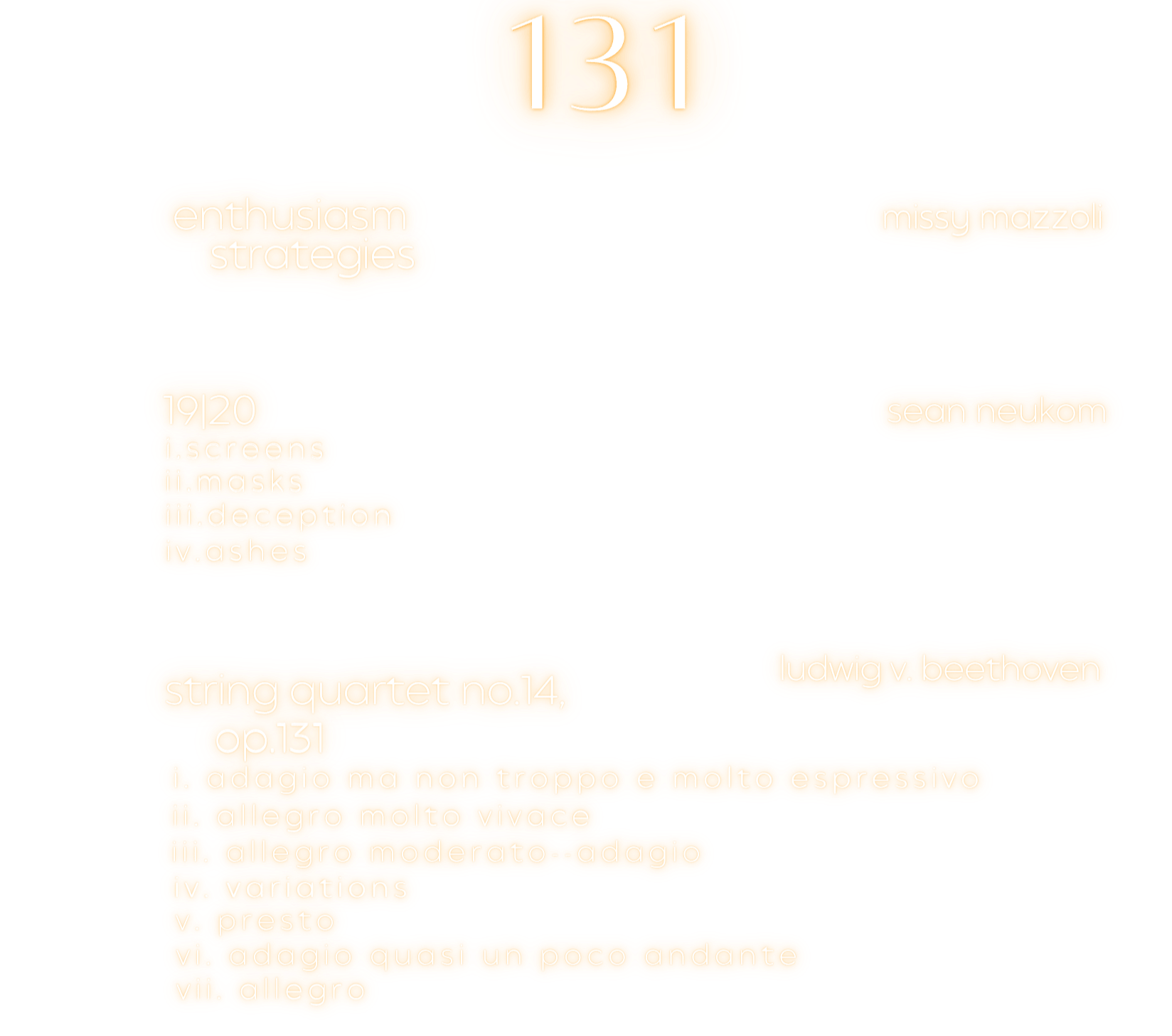
131
This Album Tells a Story
Beo String Quartet is pleased to offer this Classical Concept Album. Our hope is for you to listen to the album in its entirety as if you were in a theatre watching an opera, musical, or motion picture. No matter what style of chamber music we play—the classics, music of living composers, or music inspired by popular genres—we feel that all styles should inform and be informed by one another to help create a story that is unique to Beo.
listen | liner notes | credits | reviews
Enthusiasm Strategies
The album opens with American composer Missy Mazzoli’s Enthusiasm Strategies. Throughout the piece, whirling harmonics convey wonder and optimism, while long tones juxtaposed with fast trills and quick string crossings create a sense of struggle. Mazzoli also uses extreme, quick dynamic contrasts to create a sense of mystery throughout the work.
In the middle of the piece, a lonely, wandering melody appears in the second violin, which eventually gives way to a lush chorale in the other three instruments. This leads to a fast, weaving texture and reaches a climax before an abrupt cutoff. After an intense pause, dense long tones and unsettling harmonies begin in all four voices, which begin to calm after an initial attack. The chordal structure remains the same, repeating again and again as the sound evaporates into silence.
19|20
19|20 is composed by Beo violist and 131 producer Sean Neukom, who conceived the piece during the Covid-19 pandemic. It is a four-movement work with additional pre-recorded material, and, when performed live, includes video projection and staging. 19|20 derives its title from Covid-19 and 2020—the event and year that may have changed the direction of humanity, and certainly altered the trajectory of the arts and artists.
Screens begins with a cheerful-sounding fugato between the violins, a far cry from the calm and serene ending of Enthusiasm Strategies. Over the course of this movement, the opening motive is transformed from simple and playful, to lyrical and tender, and finally to biting and ironic. After an extended lyrical duet between the viola and cello, the final moments of the movement present the motive in a form that is truly aggressive and sinister.
Masks opens with an easy, waltz-like motive in the viola, while the other instruments comment with alternating arco and pizzicato. As the movement progresses, the opening motive gradually becomes grotesque, but this eventually gives way to a much more heroic and flowing character, with the first violin singing out the opening motive above the rest of the texture. After a thrilling climax, a pulsating ostinato can be heard in the cello, which continues until the movement ends.
Deception is the most intense and virtuosic movement of the piece. It is extremely intricate, and often alternates between homorhythmic and stretto textures in quick succession. In the middle section of the movement, the first violin finally plays a long melodic line, which gives the impression that the listener will get a break from the nearly non-stop aggressiveness.
However, underneath the melodic line, the second violin continues fragments of the opening motive. This soon gives way to disjunct rhythm between the four instruments, and the panicked motive from the opening of the movement returns.
This movement features the first instances of double tracking with pre-recorded material. While the “extra performers” may initially go unnoticed by the listener, they cannot be ignored by the movement’s climax, where the “live quartet” switches to a slower, sustained tempo leaving the prerecorded players to continue at the original tempo. The effect is striking and disorienting, especially when combined with the video and staging design of the live performance.
Ashes opens with a dark and impassioned viola improvisation. After several minutes, the remaining players enter hesitantly – like little rays of light bursting through a thick layer of ashes – changing the sonic landscape. Soon the original motive from Screens is heard in a much slower and depressed demeanor. The mood begins to shift and the tempo quickens, and gradually the depression gives way to heroic optimism.
Suddenly, the pace slows into the coda. The first violin begins an oscillating ostinato, soon joined by second violin and viola, played over a majestic anthem in the cello. With each repeat of the anthem, additional prerecorded players gradually join the texture until the sound becomes massive and orchestral, as though many voices are joined in common cause.
The music soars to a beautiful climax but the ending is unsettling, leaving the listener with more questions than answers.
131
The culmination of this classical concept album is Beethoven’s powerful and forward-looking Opus 131 quartet, cast in seven movements and played without pause. The somber and depressive opening fugue of Opus 131 can be heard as grief for all the tragedy depicted in 19|20. Following the sullen opening Adagio movement, the second movement—marked Allegro molto vivace—begins with a seamless transition to a much more cheerful manner. Beethoven manipulates the listener’s expectations in this movement, often suddenly moving from playful and elegant to rough and rustic.
The third movement, Allegro molto, is an operatic recitative of sorts with commentary in quick succession from each instrument, followed by a brief but beautiful flourish from the first violin, ending abruptly. The fourth movement’s opening Andante begins as a beautiful aria between the two violins. Such is Beethoven’s mastery of his craft that the listener only gradually becomes aware the fourth movement is actually an incredibly integrated set of variations. In his central—and longest—movement of the quartet, Beethoven takes his listeners on a journey from lighthearted and singing to the musically divine over the course of approximately seven variations.
The Presto fifth movement serves as a scherzo typically does, showing off the virtuosity of the string quartet in a boisterous and playful manner. It begins with a declamatory 4-note arpeggio in the cello, followed by the same motive in the first violin. For much of the movement, the first violin plays a quick, jovial melody while the lower three voices play a fast, spiccato accompaniment. The melody also often jumps around between two or more voices, which gives the movement
a playful, witty character. In the last of a series of inane repetitions of the opening material, Beethoven has all members of the quartet play sul ponticello (placing the bow very close to the instrument’s bridge, creating an icy, metallic sound), which adds even more peculiarity to the fast and comical movement.
The fifth movement ends joyfully with bright E major chords. Live audiences typically applaud here, and perhaps Beethoven anticipated an audience’s natural reaction, because the same chords are suddenly played again in G-sharp minor, abruptly silencing the applause and beginning the mournful Adagio sixth movement. The opening sorrowful melody begins in the viola, and then is passed to the first violin. The music gains in intensity as successive repetitions of the melody are heard, and soon gives way to the relentless seventh movement, marked Allegro.
Composed in familiar sonata-allegro form, the seventh movement’s primary theme features a march-like, violent ostinato in the lower three voices, while the first violin plays a similar rhythm in the melodic line. The listener does get a respite from the rhythmic onslaught with the secondary theme, a falling, singing line passed between the instruments over held, poignant harmonies that could be heard as a glimpse to a heavenly world beyond our own. The back-and-forth between beauty and combativeness continues throughout the movement until finally, the intense character of the movement becomes worn out, and the rhythmic ostinato transforms into a tired, poco adagio tempo. As the relentless march reaches its lowest point, the quartet suddenly accelerates, hurtling to the end of the journey—three final, heroic chords in C-sharp major.

Credits
Recording Dates | January 14-16, 2022; March 3-5, 2022; May 20-23, 2022
Release Date | January 30, 2023
Recorded by | Beo String Quartet
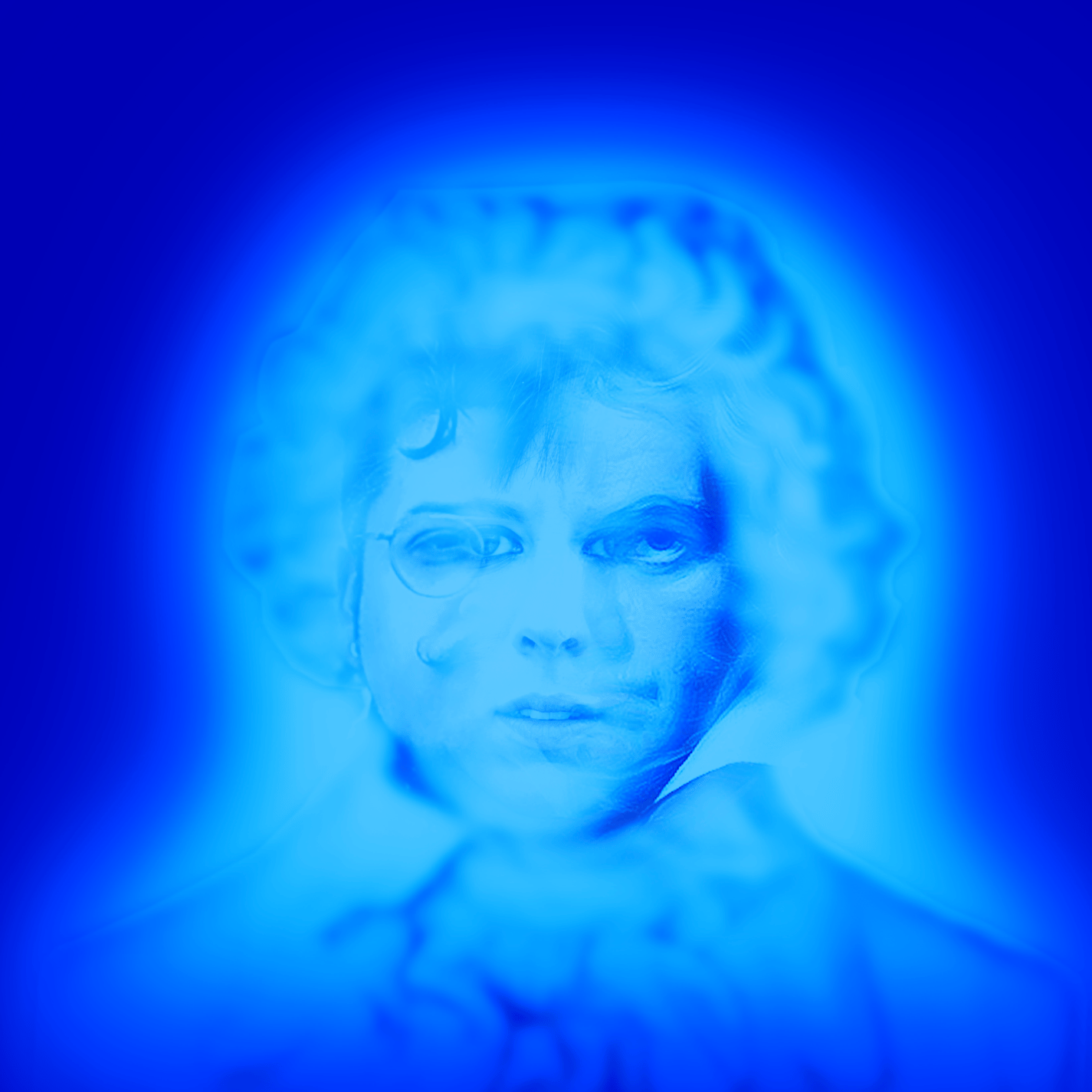
Producer, Engineer, Album Art Work | Sean Neukom
Record Lable | NeuKraft Records
"The fusion of past and present makes this release resonate with our times as few CDs do."
— Huntley Dent, Fanfare Magazine
"The Beo SQ delivers a sterling performance of Beethoven's miraculous work... Above all, the Beo is ever-attentive to the remarkable hairpin emotional twists and turns of Beethoven's narrative."
— Ken Meltzer, Fanfare Magazine
"The natural quality highlights the first-rate playing that makes the album a joy from start to finish."
— Marc Medwin, Fanfare Magazine
"The Beo recording... [is] warmer and fuller, better balanced tonally, and just more natural-sounding... 131 is a nice-sounding recording of an interesting program of highly original and imaginative music."
— Karl Nehring, Classical Candor
"The Beo String Quartet has a particularly fine sense of ensemble... each of the seven movements is given its own character while still being shown to fit within the work's overall and very complex conceptualization."
— InfoDad